Value Added Services in the Warehouse Management System
Value Added Services (VAS) are among the essential advanced functionalities of modern warehouse management systems. They encompass all value-adding services performed in addition to classic warehouse processes. Typically, a logistics service provider executes these services on behalf of the inventory owner and subsequently invoices the customer. The spectrum ranges from simple activities such as price tagging or labeling products to assembling complete component subassemblies, for instance in the automotive sector.

© Fraunhofer IML
A central prerequisite for many Value Added Services is the processing of bills of materials (BOMs). Among other functions, this enables the kitting of sets or promotional displays. While nearly all warehouse management systems can process simple, single-level BOMs, only about two-thirds of the systems also support two-level or multi-level BOMs.
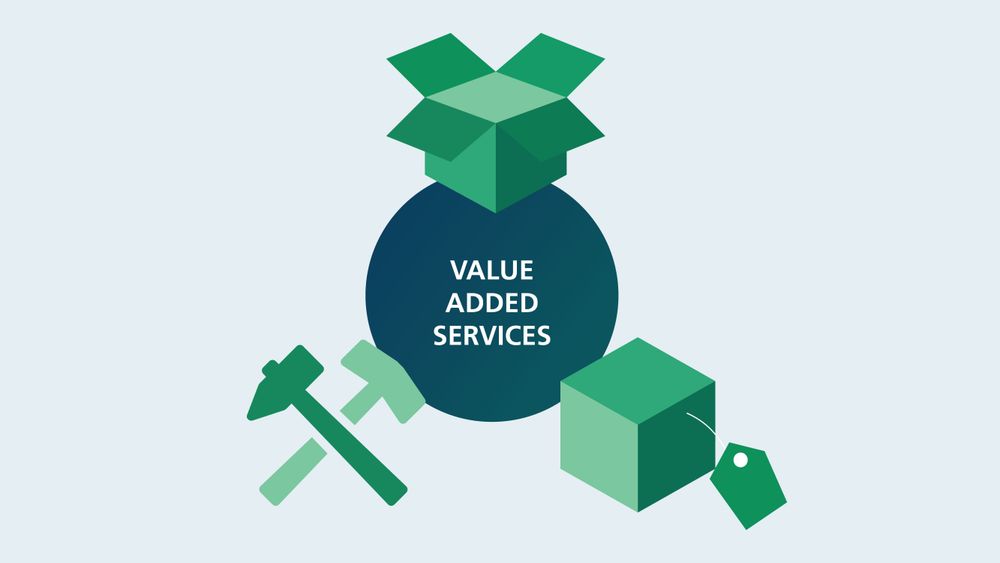
The Value Added Services supported in a WMS can essentially be divided into three areas: labeling, repacking, and assembly.
Labeling includes, for example, price tagging or affixing and sewing on labels. Modern warehouse management systems facilitate, among other things, the management of customer- or order-specific labels as well as corresponding work instructions.
Repacking comprises assembling or transferring items into sales or shipping units. In this context, the WMS takes customer-specific guidelines or requirements of the respective destination into account and controls the process accordingly.
Assembly involves assembling sets or displays as well as manufacturing simple subassemblies. In addition to processing BOMs, the WMS also supports the planning of assembly stations and batch sizes.
For all three areas, defining standard times (Normzeiten) is useful for scheduling processing times and transparently billing services. However, this functionality is supported by only slightly more than half of warehouse management systems. Even less common is the ability to automatically adjust standard times based on actual measured processing durations. The captured times subsequently serve as the basis for billing the performed services. Alternatively, Value Added Services can also be billed at a flat rate based on the number of completed process steps. The actual invoicing typically occurs within the ERP system, while the WMS provides the necessary performance and activity data.
With rising demands for individualized customer requirements and flexible logistics processes, Value Added Services have gained significant importance in recent years. Today, modern warehouse management systems support these processes much more comprehensively, enabling logistics service providers to expand their service portfolio beyond pure storage and order picking.
Terms at a Glance
-
Bill of Materials (BOM): Overview of all components, subassemblies, and materials required to manufacture or assemble a product.
-
Set (Kit): A sales unit consisting of at least two different items, such as a toothbrush and toothpaste.
-
Display: A point-of-sale display stand or retail shelf unit, frequently made of cardboard, used to present a manufacturer’s products attractively. Particularly in the food sector, lot numbers and best-before dates must be taken into account.
-
Multi-Level Bill of Materials: A bill of materials in which individual components themselves consist of further subassemblies and thus possess their own underlying BOM.