Faster from Goods Receipt to Shipping: Cross-Docking in the WMS
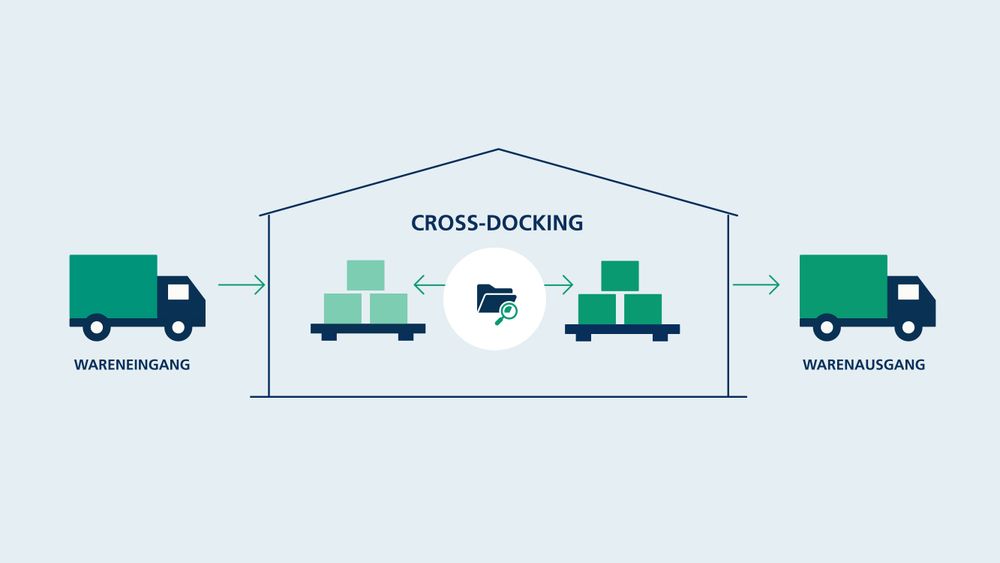
Cross-docking is among the powerful advanced functionalities of modern warehouse management systems and is steadily gaining importance alongside increasing demands for delivery speed and efficiency. By routing goods directly from goods receipt to goods issue, warehouse capacities are relieved, throughput times are shortened, and unnecessary warehouse movements are avoided. This allows process costs to be reduced and delivery performance to be improved. A prerequisite for this is that the warehouse management system automatically identifies suitable goods and directs the material flow accordingly.

© Fraunhofer IML
What Is Cross-Docking?
Cross-docking refers to a logistical procedure in which goods, upon goods receipt, are staged directly for shipping without interim storage. In principle, a distinction is made between the cross-docking of inventory-managed materials and the cross-docking of handling units (HUs) without detailed inventory information.
In the cross-docking of inventory-managed materials, stock is tracked quantitatively. In this context, discrepancies between delivered quantities and actual required quantities may occur. In such cases, additional processes are required, such as putting away residual quantities, staging missing quantities from the warehouse, or canceling already planned stock removals when they are substituted by the cross-docking process.
In cross-docking with handling units without specific inventory information, however, the contained materials are not managed individually. Instead, handling units are routed exclusively on the basis of their destination assignment—such as to a customer order, a delivery, or a tour. The contained quantities play no role in this case.
Planned and Opportunistic Cross-Docking
Another distinguishing feature is the point in time at which the process is triggered. Here, a distinction is made between unplanned (opportunistic) and planned cross-docking. In opportunistic cross-docking, the warehouse management system checks during goods receipt or goods issue whether incoming goods can be immediately utilized for open outbound deliveries. If so, the cross-docking process is initiated automatically.
In planned cross-docking, by contrast, the decision is made prior to physical goods receipt. Two variants can be distinguished here:
-
Merchandise Distribution: The decision regarding cross-docking is made in the ERP system and handed over to the warehouse management system. In direct cross-docking, goods are routed to goods issue without further processing. In flow-through, they are first processed in a repacking or consolidation area before being staged for dispatch.
-
Transportation Cross-Docking: In contrast to merchandise distribution, the focus here is not on the warehouse process, but on transport planning. Based on route or tour information, the warehouse management system determines whether a shipment is delivered directly to the recipient or routed via intermediate hubs.