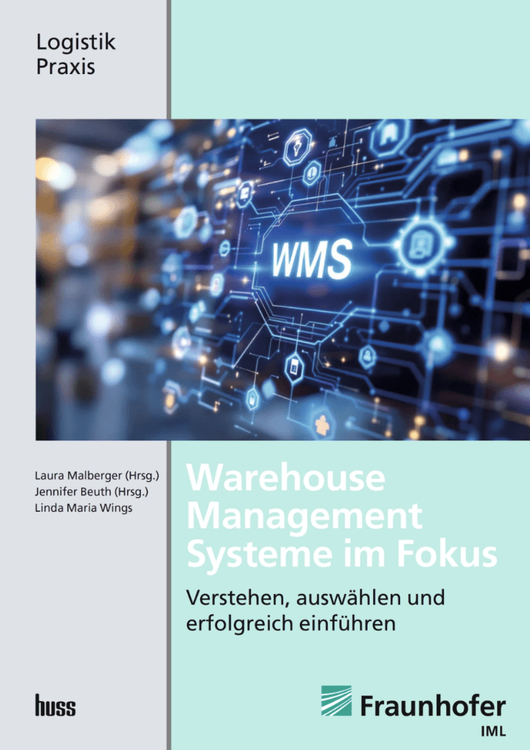
Spotlight on Warehouse Management Systems
The WMS market is complex and difficult to navigate for many companies. Numerous vendors, varying system architectures, functional scopes, and integration concepts make well-founded decision-making challenging, often leading to uncertainty among logistics managers. Key questions include: - Which WMS best fits the company's specific requirements? - Where do the systems truly differ from one another? - Which functionalities are considered standard today, and which will be critical to success in the future? - How can a WMS be successfully implemented under tight budget and time constraints? This reference book is aimed at decision-makers, project leads, and practitioners, offering actionable recommendations for every phase of a WMS project. It examines the entire lifecycle of a Warehouse Management System—from strategic positioning and vendor/system selection through to successful commissioning and go-live. Real-world case studies from numerous companies demonstrate how to systematically plan, evaluate, and execute WMS projects.
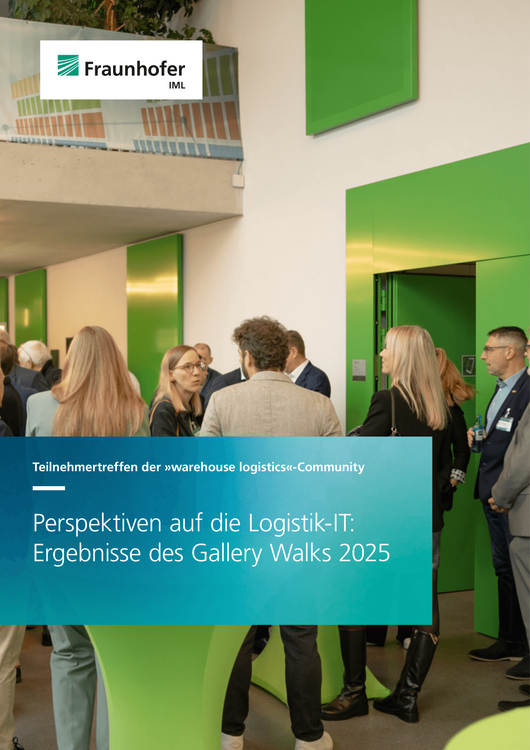
Perspectives on Logistics IT: Results of the Gallery Walk 2025
The Gallery Walk 2025 provides insights into the key issues, discussions, and outcomes of the 2025 participants’ meeting. The Gallery Walk took place as part of the 24th participants’ meeting of the “warehouse logistics” community and aimed to make different perspectives and assessments regarding future developments in logistics visible. At four thematic stations, participants engaged in dialogue, discussed the guiding question of each station, and contributed their individual experiences, expectations, and assessments. Under the overarching theme “Logistics connects – 25 years of warehouse logistics”, particular attention was given to current trend topics such as robotics and artificial intelligence, as well as upcoming developments in logistics IT systems. The results of these discussions were summarized by the moderators during the Gallery Walk and are now available for download. Bitte klicken Sie auf die gewünschte Sprache, um das Whitepaper im PDF-Format herunterzuladen:
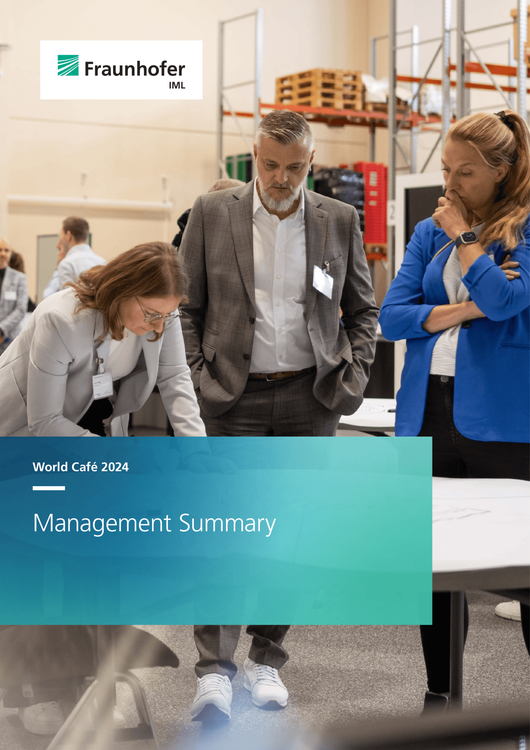
Management Summary of the World Café 2024
This year, the 23rd meeting of the »warehouse logistics« community focussed on »Innovations for a robust future: AI in logistics IT and processes«. The revolutionisation of the logistics industry through artificial intelligence is making a significant contribution to accelerated change in the future. An exchange on this complex of topics took place as part of the World Café. The main topics discussed included »Resilience in logistics«, »Artificial intelligence«, »Robotics & AMRs«, »Robust and future-proof processes« and »Compact warehouses, block storage in the future«. The results of these discussions were documented by the moderators during the World Café and summarised for the management summary. They are now available for download. Please click on the desired language to download the whitepaper in PDF format:
WMS MARKET REPORT COMPACT 2024
The »WMS MARKET REPORT COMPACT 2024« is the continuation of the study series by the »warehouse logistics« team at the Fraunhofer Institute for Material Flow and Logistics IML. The report highlights the determining market factors as well as the latest developments and research trends in the field of warehouse management systems (WMS). For 24 years, the »warehouse logistics« team has been operating one of the world's leading information platforms for comparing logistics IT systems. The data on functional and non-functional aspects recorded in the annual validations are analyzed every two years for the »WMS MARKET REPORT COMPACT«. The market report presents the trends and developments on the WMS market in a clear slide format. For example, it generates insights into the WMS market in terms of market volume or success factors. It also takes a closer look at the WMS in terms of its development priorities or functionalities in demand. This year, the focus was placed on the topic of artificial intelligence (AI). As part of the Market Report 2024, various questions were examined, including What proportion of WMS providers use AI? In what form is AI being used and what specific priorities are being pursued? These and many other questions and analyses can be found in the »WMS MARKET REPORT COMPACT 2024«. Please click on the desired language to download the whitepaper in PDF format:
Logistics IT in the Cloud
In the search for the appropriate Warehouse Management System (WMS) for their own intralogistics, users must not only define functional requirements but also address the question of deployment—namely, the method and manner of software delivery. But what does it mean in practice when a system is offered as a "cloud system," and what do users need to keep in mind? These and other questions regarding hosting, architecture, and service models of logistics IT systems are examined in the whitepaper "Logistics IT in the Cloud."

Transport Management Systems – Functional Scope, Target Groups, and Benefits
This whitepaper, "Transport Management Systems – Functional Scope, Target Groups, and Benefits," highlights the importance of Transport Management Systems (TMS) for controlling logistics chains. By examining the functional scope and the benefits of using a TMS, it demonstrates that not only freight forwarders or large logistics service providers, but also small and medium-sized enterprises in retail/trade and manufacturing can benefit from the introduction of a TMS. In doing so, it is crucial to select the right system for one's individual use case. After all, not every TMS offers the same functionalities, and not every company has the same process requirements.
Survey on personnel resource planning in warehouses - European results
166 European warehouse locations took part in the survey. From logistics service providers to manufacturing companies and retailers, both small and medium-sized enterprises and large companies answered questions about their current approach to resource planning in the warehouse. The Fraunhofer IML is thus creating transparency about the current use of resource planning systems (RPS) in warehouses. The results show which tools and methods the locations use for personnel resource planning in the warehouse, which criteria are used and how satisfied they are with the solution currently in use. A special focus is placed on the use of resource planning systems. It looks at how the RPS is integrated into the existing system landscape and which other logistics IT systems are used by the companies. The survey also provides exciting insights into the benefits of an RPS and the implementation challenges to be expected when introducing an RPS. Please click on the desired language to download the whitepaper in PDF format:
Survey on personnel resource planning in warehouses - Italian results
The Italian results of the »Survey on personnel resource planning in warehouses« aim to create transparency about the current use of resource planning systems in warehouses and to disseminate knowledge about possible tools and methods for personnel resource planning in logistics. In order to gain a comprehensive insight into personnel resource planning in warehouses, 54 locations of at least 35 companies from different sectors and company sizes were taken into account. The survey was conducted exclusively at Italian locations. In addition to the tools and software presently employed, the survey offers insights into the criteria currently considered in personnel resource planning. It also takes a closer look at companies that already have an RPS in place and provides an overview of the type of software used, the surrounding IT system landscape and the integration of the RPS into it. It also highlights the decisive factors for the introduction of an RPS and the expectations regarding the challenges and benefits associated with its implementation. For the locations that already use an RPS, it also shows which groups were involved in the decision-making process and how it was received by the employees. Please click on the desired language to download the whitepaper in PDF format:
Pallet Flow and Pallet Shuttle Rack Systems
In the dynamic and constantly evolving world of intralogistics, it is of great importance to make well-informed decisions when selecting technologies for a specific application. This whitepaper examines two rack systems for high-density storage: the Pallet Flow System and the semi-automatic Pallet Shuttle System. Both solutions cover a similar range of applications and offer different advantages and disadvantages through their functions and mechanisms. Please click on the desired language to download the whitepaper in PDF format:
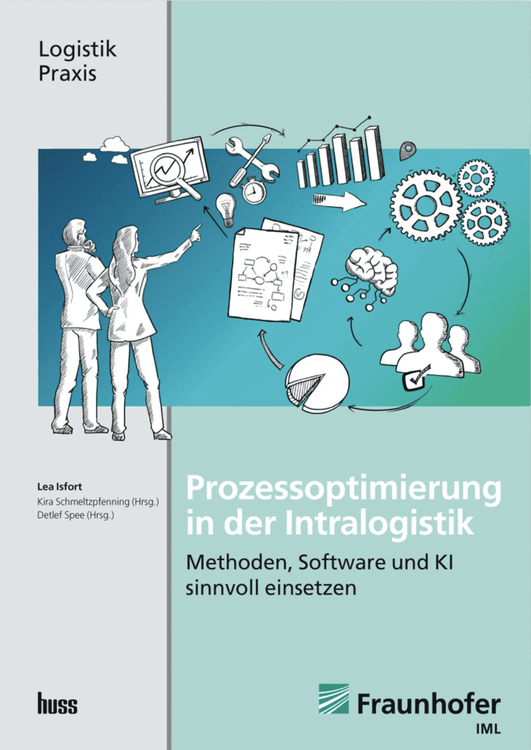
Process Optimization in Intralogistics – Sensibly Deploying Methods, Software, and AI
As a reference work and source of ideas for the redesign of warehouse processes, the Fraunhofer Institute for Material Flow and Logistics IML publishes the specialist book »Process Optimization in Intralogistics – Sensibly Deploying Methods, Software, and AI« with HUSS-VERLAG. Following the motto »Think big, start small«, readers are provided with methods and mindsets to implement ambitious goals in small steps and continuously advance them. The book is structured into three chapters. First, methods are explained to structure and analyze processes. Subsequently, opportunities are highlighted on how processes can be optimized through the targeted use of software. In the third chapter, a look is taken at the topic of artificial intelligence and its fields of application for process optimization in intralogistics. Following each chapter, the theoretical content is illustrated with application examples and real-world success stories.
Management Summary of the World Café 2023
With the »Management Summary of the World Café 2023«, you gain an overview of the key topics and results of the 22nd participant meeting of the »warehouse logistics« community. Under the motto »What will logistics IT look like in 2035?«, the 22nd participant meeting of the »warehouse logistics« community took place. An interactive exchange was offered by the World Café, which actively fostered discussion among participants. The group moderators documented the topics discussed. The documentation of the exchange was presented in the »Management Summary of the World Café 2022«. The following topics were discussed in the plenary session: »Intralogistics in 2035«, »Future Work with AI and Logistics IT«, »Gamification«, »Simplifying Logistics IT«, and »New Work in Logistics IT 2035«. As of now, the detailed results of the exchange are available for download as a digital brochure in the form of the »Management Summary of the World Café 2023«.
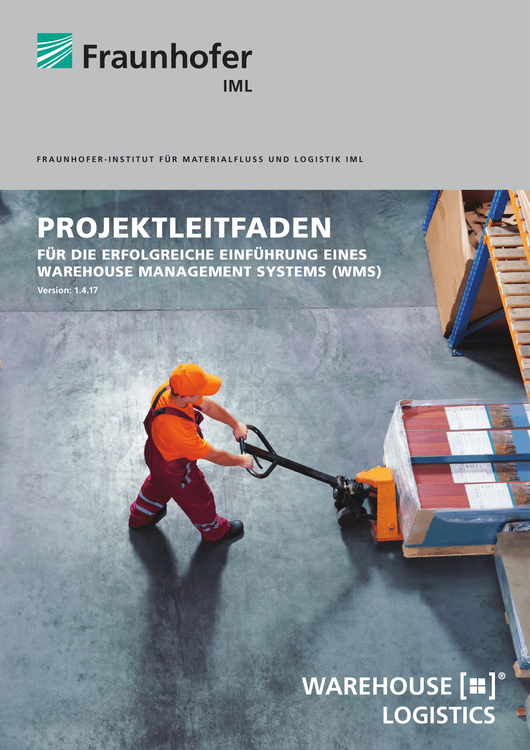
Project Guide for the Successful Implementation of a WMS
The 10 Golden Rules of WMS Implementation On the participants meeting 2014, the »Project Guide for the successful implementation of a Warehouse Management System (WMS)« has been presented for the first time, which was previously developed in collaboration with the advisory committee »warehouse logistics«. This idea resulted from the discussion round on the topic "go-live strategy" during the participants meeting in 2012 and has now been finalized in a large group. The »10 Golden Rules of WMS implementation« provide a good basis for the successful and goal-oriented roll out, go-live and subsequent transfer into regular operation of a (new) Warehouse Management System. Therefore, this project guide aimes at all companies that are about to implement a new, or replace an existing WMS. Please click on the desired language to download the whitepaper in PDF format:
Management Summary of the World Café 2022
The "Management Summary of the World Café 2022" provides you with insights into the main topics of the 21st meeting of the "warehouse logistics" community. The 21st meeting of the "warehouse logistics" community took place under the motto "100% logistics IT". An interactive program was used to exchange ideas between the participants. As part of the World Café, the exchange between the participants was actively promoted and the topics discussed were documented. The documentation of the results is shown in the "Management Summary of the World Café 2022" and includes the topics: "AMRs as all-rounders? - Challenges and opportunities of new developments", "Sustainability - what does the market demand", "Load-oriented resource planning in logistics IT systems", "Quo vadis TMS - trends and drivers for TMS" and "Developing open source together!". We provide you with the detailed content by downloading the "Management Summary of the World Café 2022" as a digital brochure. Please click on the desired language to download the whitepaper in PDF format:
WMS MARKET REPORT COMPACT 2022
With the »WMS MARKET REPORT COMPACT 2022« the »Team warehouse logistics« of the Fraunhofer Institute for Material Flow and Logistics continues its research series on market-determining factors as well as current developments and research trends of »Warehouse Management Systems« (WMS). As a continuous long-term study, the »WMS MARKET REPORT COMPACT 2022« provides a transparent and comprehensive overview of trends and developments of the increasingly complex WMS market. The focus is on the influences and future changes for the WMS market, standard WMS and WMS projects. The market study provides information on various questions: Which criteria are particularly relevant for WMS users when selecting a WMS? Does the providers' product portfolio contain IT software to complement the WMS? How often is which type of project carried out? Which development trends will be significant in the future? What are the most demanded K.O.- criteria in the WMS selection? Which cloud architectures are preferred for implementation? Detailed analyses, answers and questions on these and many other topics can be found in the »WMS MARKET REPORT COMPACT 2022«. Please click on the desired language to download the whitepaper in PDF format:
Use of RPS in SMEs
Together with the Mittelstand-Digital Zentrum Ruhr-OWL, the »warehouse logistics team« focused on small and medium-sized enterprises (SMEs) regarding the software-supported planning of personnel resources and compiled the results in a study. Rapid adaptability, high flexibility, customized lot sizes, and fluctuating personnel requirements: logistics companies must meet numerous requirements to remain competitive. Through the use of technology and software, the aim is to increase productivity and enhance planning accuracy. The selection of a resource planning system (RPS) plays a decisive role in this. Under the title »Human Integration – Digital Planning of Personnel Resources in the Mittelstand«, the study explores the questions critical to selecting an RPS and examines functionality, added value, and hurdles during implementation. Please click on the desired language to download the whitepaper in PDF format:
Guide for Successful Software Testing in Intralogistics
With the publication of the white paper, the »Team warehouse logistics« of the Fraunhofer Institute for Material Flow and Logistics IML provides a transparent overview of the topic of software testing in intralogistics and thus supports the »warehouse logistics« community in its ideal use. With the help of software tests, it should be checked whether the specified functionalities and processes on the part of the software are fulfilled and run without errors. Due to the high range of functionality, it is difficult to prove that the software is free of errors in a compact way. Therefore, all functionalities and processes are to be tested by means of scenarios defined in advance, so that errors can be avoided. Because the later these errors are discovered, the more expensive they are to correct. In addition to the preparation and execution of software tests, the white paper is intended to help with their successful use and describes the structure of the test documents, the detailed procedure for testing, as well as the handling of test deviations and successful execution including go-live. Please click on the desired language to download the whitepaper in PDF format:
Logistics IT in Transition
The whitepaper »Logistics IT in Transition« sheds light on the challenge of an increasingly modular system architecture in logistics. It was created within the framework of the Leistungszentrum Logistik und IT in collaboration with various scientific institutions. Under the umbrella of the Leistungszentrum Logistik und IT, research institutions collaborate that already—each on its own—shape and drive logistics research forward today. Logistics IT is undergoing a transition. Whereas large, monolithic software systems previously controlled end-to-end processes in the warehouse, enterprise, and supply chain, in recent years these have been increasingly supplemented and replaced by a multitude of modular software packages. Key elements on the shop floor include cyber-physical systems (CPS), which operate autonomously, make decentralized decisions, and thereby strive for the current optimum at any given time. The whitepaper »Logistics IT in Transition« examines the requirements that an autonomously operating manufacturing environment imposes on higher-level and subordinate IT systems, and identifies fields of action for the integration of a cyber-physical production system (CPPS) into the enterprise architecture.
RPS Study: Software-Supported Planning of Personnel Resources in the Warehouse
This RPS study provides an important overview of the topic of software-supported planning of personnel resources. The interdisciplinary team of experts from the Fraunhofer Institute for Material Flow and Logistics IML, »team warehouse logistics«, together with experts from Fraunhofer Austria and industry partners, investigated the degree of digitalization of personnel planning and control in an intralogistics context. Gathered through a market and user study, the current and future use of resource planning systems at warehouse locations as well as the offerings of RPS software vendors are presented. With a focus on intralogistics, the study highlights cross-industry differences and similarities in the use of systems. The results of the 115 completed online questionnaires were analyzed and prepared with regard to three defined core questions and eight associated hypotheses in order to illustrate the degree of digitalization of personnel resource planning in intralogistics. The study also captures the expectations of companies regarding the greatest challenges in the implementation of an RPS as well as the actual resulting benefits.
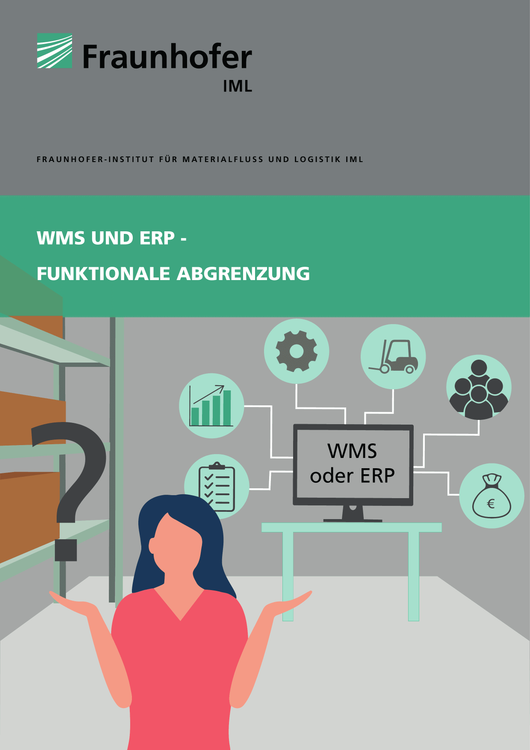
WMS and ERP – Functional Demarcation
With the whitepaper »WMS and ERP – Functional Demarcation«, the »warehouse logistics team« at the Fraunhofer Institute for Material Flow and Logistics IML addresses a frequently debated question: Is this a WMS or an ERP functionality? Building upon a functional boundary definition of the two systems, the whitepaper also explores functionalities that must be allocated on a project-specific basis. Many end users and system owners find it difficult to distinctly assign specific features and modules to either the WMS or the ERP system. Furthermore, the increasing blurring of system boundaries exacerbates this lack of clarity and transparency. The whitepaper »WMS and ERP – Functional Demarcation« is designed to support practitioners in delineating the operational scope of WMS and ERP systems. In addition, it aims to raise awareness regarding the integration and operational challenges arising from functional overlaps. Concurrently, it explains and contrasts the different deployment architectures—evaluating a WMS as an integrated module within an enterprise ERP suite versus an independent, specialized best-of-breed (stand-alone) solution.
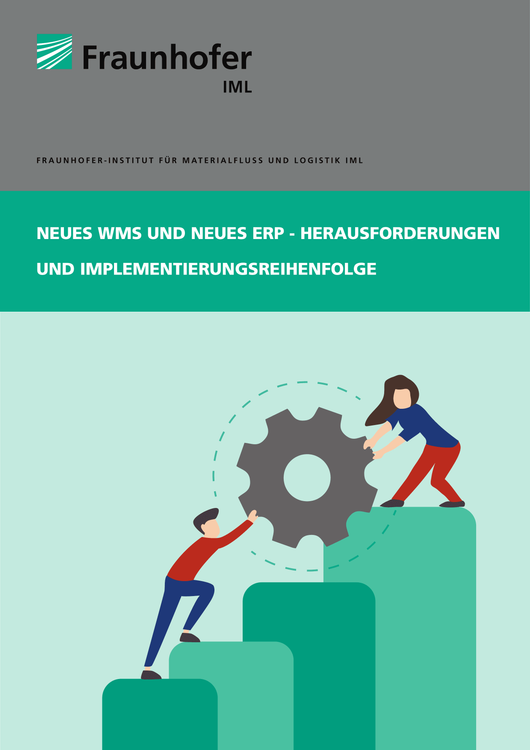
New WMS and New ERP System – Challenges and Implementation Sequence
The whitepaper »New WMS and New ERP – Challenges and Implementation Sequence« by the »warehouse logistics team« is intended to sensitize you as a user to the various possible approaches regarding the implementation sequence of a WMS and an ERP system. In addition to defining potential factors influencing the sequence of implementation and prioritizing these factors, the whitepaper identifies the most sensible implementation sequence of ERP system and WMS for various scenarios. In addition, the execution of a simultaneous implementation of both systems is examined. Furthermore, prerequisites for the successful outcome of such a project are formulated. Practical project experiences of industry experts as well as the expertise of the »warehouse logistics team« are consistently taken into account throughout.
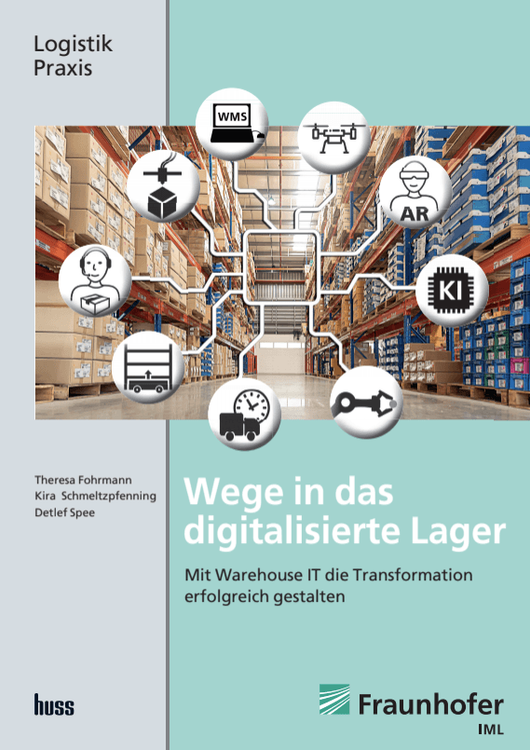
Pathways to the Digitalized Warehouse
With the book »Pathways to the Digitalized Warehouse«, Fraunhofer IML publishes a practical guide for successfully managing the digital transformation of your warehouse operations. The publication provides guidance for getting started as well as taking the next steps toward warehouse digitalization. Numerous real-world case studies from companies across various industries allow you to learn from the experiences of others. It covers both the types of digital tools and technologies deployed and the strategic approaches required to successfully implement digitalization initiatives. Alongside the focus on technology, particular emphasis is placed on successfully integrating personnel and the human factor into the digital transformation process.
Digital Transformation – Logistics Service Providers in change
Increasing and changing customer requirements as well as the availability of new technological developments faces logistics service providers with new challenges that can hardly be met without digital support. The study "Digital Transformation - Logistics Service Providers in change" gives you an overview of which customer requirements and technological developments have influence on your business as a logistics service provider and which measures you can take to meet them. Please click on the desired language to download the whitepaper in PDF format:
Market Overview of SAP EWM Implementation Partners
With the whitepaper »Market Overview of SAP EWM Implementation Partners«, the Fraunhofer Institute for Material Flow and Logistics IML provides a guide for selecting a suitable implementation partner for warehouse management systems (WMS). Companies that have opted for an SAP strategy and the support of their warehouse processes through »SAP Extended Warehouse Management (EWM)« gain a comprehensive overview of the market. A successful WMS project requires the right choice of both software and partner. Whether implementing a WMS for the first time, replacing a proprietary system, or substituting legacy SAP Warehouse Management, finding the appropriate partner is a challenge. Decisive for the success of the resulting—often 10 to 15-year—partnership are functional aspects, experience with SAP EWM projects, and industry expertise. The »Market Overview of SAP EWM Implementation Partners« offers the opportunity to match the individual requirements of the user with the available market offerings. To this end, partner status and customer structure are examined, as well as global availability, degree of innovation, and project methodology. Equally considered is experience with technical aspects, such as the integration of storage and picking technologies, the availability of add-ons and cloud solutions, as well as connectivity to non-SAP ERP systems.
When and Why Do I Need a WMS?
With the whitepaper »When and why do I need a WMS?«, the »Team warehouse logistics« of the Fraunhofer Institute for Material Flow and Logistics IML provides a compact overview of the introduction, selection and benefits of a warehouse management system. In addition to suggestions and thought-provoking ideas the paper also deals with concrete proposals. Many companies find it difficult to decide for or against a »Warehouse Management System«. Although most are aware that they are in the middle of the age of digitalisation, the fear of not making the right choice is too great. For the majority, this dichotomy is not least due to the high investment costs and the time required to implement a WMS, which should undoubtedly not be underestimated. The reasons for introducing a »Warehouse Management System« can be manifold: shorter throughput times, automation of processes, coping with smaller batch sizes and a higher variety of variants as well as ensuring inventory security are possible arguments and requirements for this. But unfortunately, the performance capability of a WMS is still underestimated. That is why the »Team warehouse logistics« has taken up this issue and published the whitepaper »When and why do I need a WMS«. Please click on the desired language to download the whitepaper in PDF format:
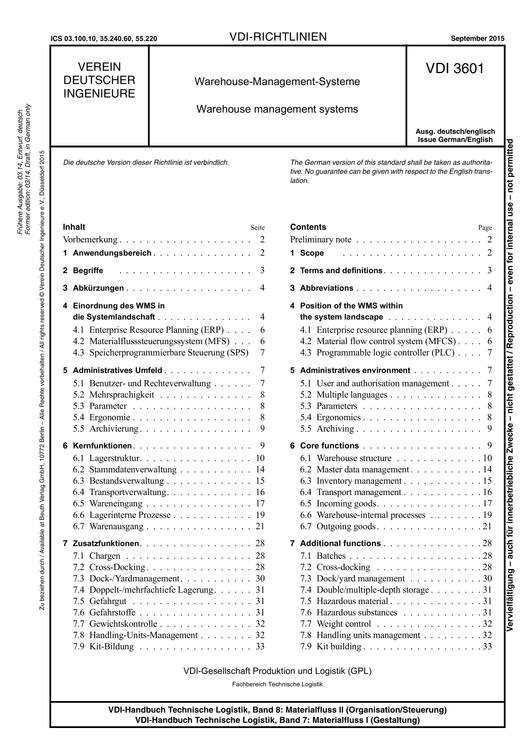
VDI Guideline 3601
Warehouse management refers to the control, monitoring, and optimization of warehousing and distribution systems. This encompasses inventory management (including quantity and bin/storage location management as well as material handling control and dispatching), comprehensive methods and tools for monitoring system states, and a selection of operational and optimization strategies. The primary objective of a Warehouse Management System (WMS) is the guidance, management, and optimization of intralogistics storage and conveying systems. To fulfill these tasks, the subordinate system layers (such as Material Flow Systems / programmable logic controllers) must deliver the requisite throughput, data quality, and system stability. The guideline outlines the functional scope and operational responsibilities of an IT system designed for warehouse management. It establishes standard terms and abbreviations, defines the administrative and functional environment, and explains the integration of a WMS into higher-level enterprise systems (e.g., ERP) and subordinate control systems. The guideline was developed by the »warehouse logistics« community. More than 90 experts and companies from two VDI Technical Committees and the »warehouse logistics« advisory board contributed to its creation.
No results
Try a different filter.