Successfully Implementing a WMS: Ten Success Factors for Stable Projects
The implementation of a Warehouse Management System (WMS) is far more than a pure IT venture: it is a strategic project that transforms operational procedures in the warehouse, administrative processes, and cross-departmental collaboration. Implemented correctly, a WMS improves inventory visibility, reduces sources of error, supports order processing, and establishes the foundation for stable, standardized processes. For the transition into regular operation to succeed, all core fields of action must be structured and managed bindingly from the outset.

© Fraunhofer IML
Project Planning and Controlling Secure the Framework
The project guide from Fraunhofer IML demonstrates that project success is established well before go-live. Crucial elements include a clear project plan with realistic milestones, an organizational chart, defined work packages, and active controlling for costs, schedules, and requirements. Equally important is a regulated procedure for handling changes, as change requests are virtually unavoidable in dynamic projects.
Ten Success Factors Structure Implementation
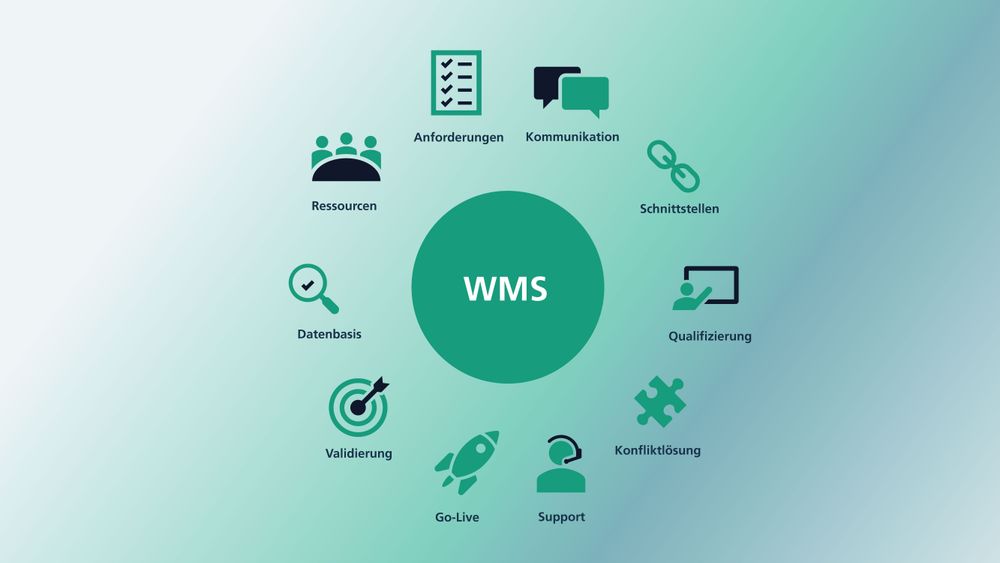
The implementation of a new WMS represents a pivotal milestone for digitalization and efficiency gains in intralogistics. To minimize risks, adhere to project schedules and budgets, and achieve high employee acceptance, a structured approach is essential. The following ten success factors form the foundation for a WMS implementation—from the initial requirements analysis to permanently stable operations:
- Neatly describe processes and anchor requirements in the functional specification
A precise as-is analysis and the definition of target processes form the basis of the entire project. Clearly translating logistical requirements into a detailed functional and technical specification (Lasten- und Pflichtenheft) is essential. The more precise the specifications are at the beginning, the more targeted the selection and configuration of the WMS can be.
- Establish communication, roles, and decision-making paths early
Transparency fosters acceptance. From day one, clear responsibilities, decision-making authorities, and communication channels within the project team provide structure. Short reporting and decision-making paths prevent bottlenecks and keep the project on schedule.
- Plan project team members bindingly and create capacity
A WMS implementation cannot succeed “on the side.” Internal resources and subject matter experts must be bindingly allocated to the project and visibly relieved of daily operational duties. Only in this way can team members dedicate themselves to project tasks with focus.
- Fully define interfaces to ERP, MFS, and additional systems
A WMS unfolds its full potential only through seamless integration into the existing IT landscape. All interfaces to adjacent systems—such as ERP, TMS, or shipping service providers—must be defined early on.
- Examine and cleanse master data, transactional data, and legacy data early
The performance of a WMS stands and falls with data quality. The timely analysis, cleansing, and structuring of master data, transactional data, and inventories prior to migration is critical. To prevent data errors in the new system, obsolete or incorrect records should not be migrated.
- Train key users and operational staff throughout the project
The early involvement of key users and warehouse staff is a critical success factor. Practical training helps eliminate hesitations, secures valuable real-world feedback, and ensures safe command of the system from day one.
- Plan tests systematically
A well-thought-out testing concept covers all scenarios: from individual functional and interface tests to data migration tests and realistic load testing under full workload prior to the actual launch.
- Agree on escalation levels for structured conflict resolution
Unforeseen challenges arise in complex IT projects. Predefined escalation levels ensure that conflicting priorities or delays are addressed objectively, quickly, and in a solution-oriented manner.
- Prepare go-live realistically and provide ramp-up support
The day of system cutover requires thorough planning. A structured schedule for go-live and intensive on-site support provided by the project team and the software vendor ensure a successful system launch.
- Clarify support, responsibilities, and operating concepts after launch
Regular operation begins after go-live. The operating concept for the post-launch phase must be clarified in a timely manner: this includes defining first-level support and establishing clear Service Level Agreements (SLAs) with the vendor. These secure long-term system stability and continuous optimization.
The Overview Supports Planning and Alignment
This overview can serve as a guiding framework in daily project routines for status meetings, alignment, and internal decision-making. It highlights which items must be settled prior to go-live and which topics are transferred into regular operation after launch. Consequently, the guide becomes not merely a summary, but a practical orientation tool for clients, the project team, and the involved business departments.
Stable Implementation Emerges Through Interaction
A successful WMS project does not depend on a single factor. Decisive is the interaction of thorough preparation, resilient data, qualified personnel, systematic testing, and a clearly defined operating concept. Anchoring these elements early reduces the risk of delays, budget overruns, and instability during ongoing operations.
The Whitepaper Expands on the Project Guide
For more comprehensive information, we recommend downloading the Fraunhofer IML whitepaper: “Project Guide for the Successful Implementation of a Warehouse Management System (WMS)”.